
I Have One Absolute Rule for Figure Skating. Sort of.
I have one rule and one rule only when it comes to my figure skating practice: if I’m not having fun, I pack it up and leave.
In reality, I’ve not had to apply this rule more than a handful of times in the five years I have been figure skating. But when I have, it’s always felt fantastic. Liberating, even. It alleviates a lot of the pressure that comes along with training the sport of figure skating, which cultivates a peculiar type of intensity to begin with.
When the rink is full of screaming kids on their Christmas break, shoving metal skate supports (there has to be a better word for this?!) at each other and failing to understand the actual knives on the bottom of my feet, then it’s not time to guilt myself into perfecting the twizzles in my choreography sequence, to work on deep edges in the back outside counter (oh hell no), and not even to spin, because that attracts them like moths to Lamp.
Those are the times to walk (well skate, then walk, I suppose) away. Go home and take a hot bath, stretch. Life is good, and the rink will be there tomorrow.
There are a couple other types of “no fun,” in my experience, and I actually deal with them in slightly different ways. There is the “just not feeling it” session, which I’ll go into next, and the “Oh God I’m so frustrated, nothing is working” type of session. Both uniquely unpleasant to experience, but both of these types of sessions can actually turn out to be quite productive and, often in retrospect, really quite satisfying.
For clarity:
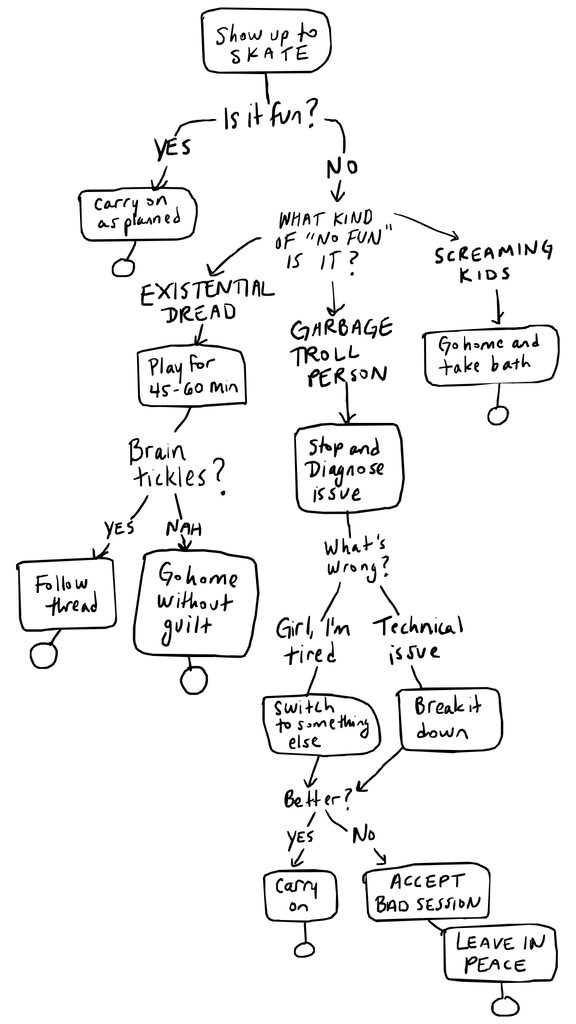
The “just not feeling it” session is distressing because this is the one that reaches out and taps the shoulder of the existential dread. It’s the “We don’t even like skating; we believe in nothing, Lebowski” of the practice sessions.
When I start to question if I ever even liked skating to begin with and oh-god, what am I doing with my life (see: So What if I Don’t Feel Like Skating?), I lean into it.
First, I give myself a set amount of time to keep skating. Nothing too long, but also not too short. 45 minutes to an hour, max, at which point I am free to continue my regularly scheduled practice if I’m inclined to do so, or I am free to leave without guilt if I never end up getting into a groove.
Usually, I try to keep my practices quite structured in order to help me spend the time well without it feeling daunting. I generally divide my sessions into thirds: steps, jumps, and spins, though not necessarily in that order (but always steps first). There’s more to it than that, but I’ll get into it another day. And if I really get into a groove with something, I will change my plan to keep going with whatever is working well or exciting me during the session.
However, on those “not feeling it” days, that structure becomes momentarily useless. Unless I am in a lesson, there is nobody telling me what I have to do (and even then, I think there is quite some leeway as an adult skater!). So I just start to play: skate a few rounds with sticky feet on the ground and pretend I’m a roller skater, or noodle around with footwork that makes my brain tickle. “What if?” becomes the most important question, followed by my feet trying to answer it. If my blades are already dull, I might play around with slides. Maybe have a chat with a fellow skater for a few minutes (but not long enough to cool down; that is the kiss of death to the session).
And nine times out of ten (well, it doesn’t even happen that often so nine times sounds like too many times!), that little detour will be enough to spark something. I’ll follow whatever thread I ended up finding and let it lead into something, anything. Sometimes that’s back into my regularly scheduled practice; sometimes it’s a fun combination I never thought of before, or a challenging transition or move. It doesn’t really matter. “We believe in nothing!” And if after trying out this route I am still not having any fun, then well, 45 minutes is not all that long anyway and I tried some new things out in the process.
I skated. That’s the most important part. And maybe I even found a new rug to tie the proverbial room together. (This whole metaphor only makes sense if you’ve seen The Big Lebowski, which, really, go watch it if you never have.)
Your brain might not tickle from noodly footwork, but something else will surely do the trick. What about trying out hydroblading, what about cartwheels, how about some spirals? Anything to break from what you think you need to practice. No pressure, no expected result. Just play.
The other type of “no fun” session is a real doozy: it’s the “Oh-god, why isn’t anything working, I am a garbage skater and a garbage troll person” session that visits us all from time to time.
I mean, I assume it touches us all.
If you can’t relate, then I am quite jealous, as a matter of fact.
I think the cause of this can be physical, mental, or most likely, it’s a combination of the two. Why yes it is quite possible that my jumps are hot garbage after a terrible night’s sleep, or not enough warmup, or that I’m still tired from yesterday’s practice. If I can’t center a spin to save my life, then I’m probably dropping the hip on the free leg or forgetting some other fundamental.
The most important thing to do in this instance, I find, is first to stop and think. Am I tired, or am I forgetting something? (Yes.) Once I know that, I can take the proper corrective action. Are you physically too tired because you are perhaps also forty-four years old and for some reason trying to learn doubles, or maybe you’re not and you just have too much dang homework? Don’t force it; switch to something else. You don’t want to hurt yourself.
Are you physically okay but unable to pinpoint what’s going wrong? Break the move up into smaller pieces. Take it back to the absolute basics. Scratching on that left outside 3-turn? Put your right foot down and practice the turn on two feet instead of one. Inevitably you’ll discover an error in body position or timing that you’ll be able to feel much better on two feet. If you go all the way back to square one and you still can’t figure it out, then it’s better to table the move and ask someone about it later. This keeps you from practicing incorrectly and possibly drilling in a bad habit (RIP my axel).
Maybe it’s just that the toe jumps are not working and it’s fine once you switch to edge jumps. Or maybe jumping is not working altogether; so go to spins or steps instead.
Something something about drastic somethings calling for drastic measures.
It’s been my personal experience that when one type of move is not working, another one inevitably will instead.
And if not? Well, crying in the bathroom is always an option.
I kid, I kid. Well, kinda. There have been times I have been so frustrated with myself that I’ve cried at the rink, but I wouldn’t exactly recommend it as a standard reaction. The emotions can get up there because we care about what we do (Oh hey, I guess I DO like skating after all!), but this is also when we need to circle back to the FUN we are supposed to be having figure skating in the first place.
When faced with a big ol’ nothingburger session where nothing is going right, remember that sometimes we just have bad practices and that they make up a small part of the larger landscape of mostly good practices. And that the next session has a 99.9999% chance of being better than this one. The time is not wasted. The hopelessness, once contextualized, gains its place.
Thinking this way allows me to leave the rink with a much more peaceful feeling than if I were to focus on how badly I thought I skated that day. “I kinda sucked today, but I did it anyway.” The perseverance itself brings satisfaction.
You gotta give yourself some grace while you’re out there trying to get graceful.